


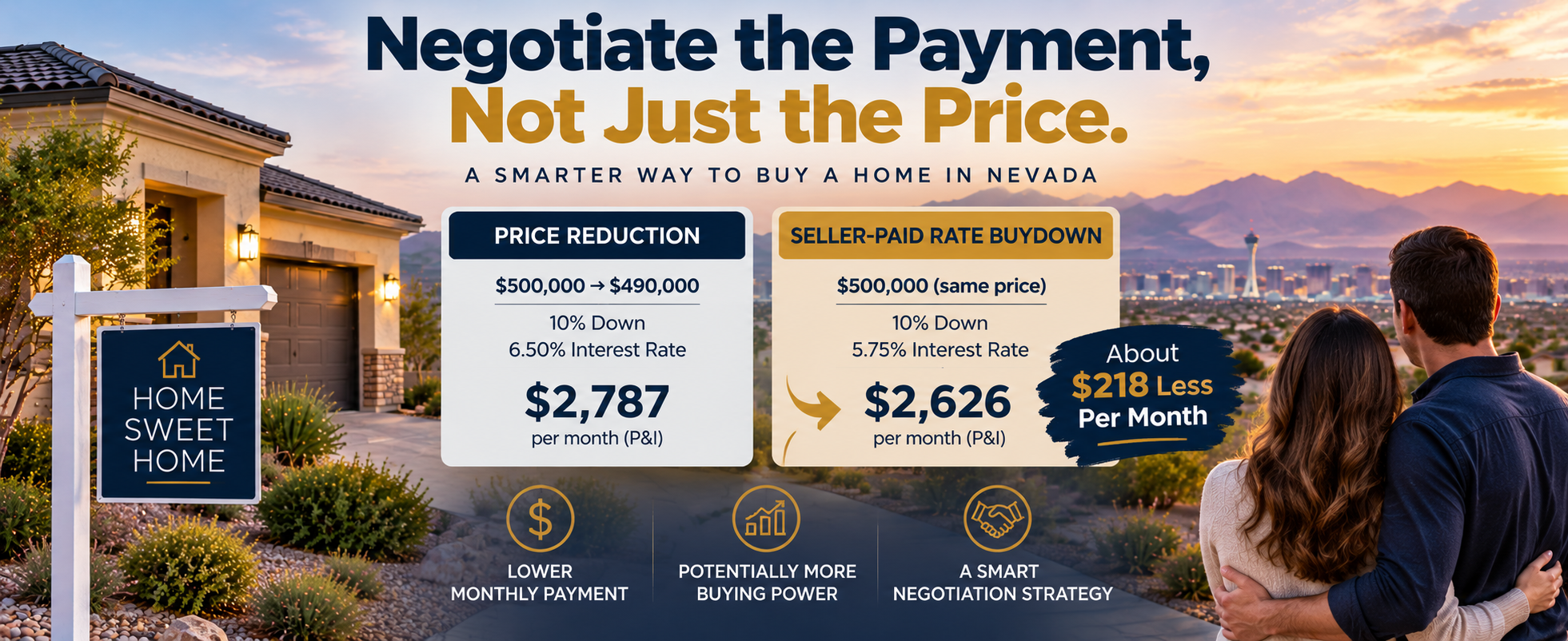
Could a Seller-Paid Mortgage Rate Buydown Save You More Than a Price Reduction?
Sometimes the Interest Rate Matters More Than the Price
When negotiating a Nevada home purchase, asking the seller to reduce the price may seem like the obvious way to save money. But a price reduction does not always create the largest reduction in your monthly mortgage payment.
Depending on the loan program, lender pricing, seller contribution limits, and your financial situation, negotiating a seller credit applied toward a permanent mortgage interest rate buydown may produce a significantly lower monthly principal and interest payment.
A lower qualifying payment may also increase purchasing power for some borrowers. That means the negotiation can affect not only what you pay each month, but also the price range of homes you can consider.
What If You Negotiated the Payment Instead?
Imagine a seller is willing to negotiate approximately $10,000. There may be more than one way to use that negotiating room. One option is to reduce the purchase price. Another may be to negotiate a seller contribution toward eligible financing costs, including discount points that permanently reduce the mortgage interest rate.
Option 1: Reduce the Price
Reduce a hypothetical $500,000 purchase price to $490,000. With 10% down, the mortgage amount would decrease by approximately $9,000.
Option 2: Negotiate a Seller Credit
Keep the $500,000 purchase price and, when permitted, negotiate a seller contribution that can be applied toward eligible discount points to permanently reduce the mortgage interest rate.
$500,000 Home: Price Reduction vs. Rate Buydown
Consider a hypothetical buyer purchasing a $500,000 home with 10% down and a 30-year fixed-rate mortgage. For illustration only, assume the standard interest rate is 6.50%, and assume lender pricing allows the negotiated seller contribution to reduce the rate to 5.75%.
$10,000 Price Reduction
- Purchase price: $490,000
- Down payment: 10%
- Approximate loan amount: $441,000
- Illustrative interest rate: 6.50%
Approximate monthly principal and interest.
Seller-Paid Rate Buydown
- Purchase price: $500,000
- Down payment: 10%
- Approximate loan amount: $450,000
- Hypothetical bought-down rate: 5.75%
Approximate monthly principal and interest.
The Same Negotiation Can Affect Your Payment Differently
Approximate monthly P&I reduction from the hypothetical $10,000 price reduction.
Approximate monthly P&I reduction from the hypothetical permanent rate buydown compared with the original $500,000 example at 6.50%.
Approximate additional monthly P&I savings from the rate strategy compared with the $10,000 price reduction in this example.
Important: These figures are hypothetical illustrations. The cost of discount points and the interest-rate reduction available for a particular amount can vary significantly by lender, loan program, credit profile, occupancy, loan amount, property type, and market conditions.
A Lower Rate May Help You Qualify for More Home
Mortgage qualification depends on income, monthly debts, credit, down payment, property taxes, homeowners insurance, mortgage insurance, homeowners association dues, interest rate, and other underwriting requirements.
Because the interest rate affects the monthly principal and interest payment, permanently reducing the rate can reduce the payment used in qualifying calculations for certain mortgage programs.
That does not mean every buyer will qualify for a larger mortgage. However, for a borrower whose qualifying ratios are constrained by the monthly housing payment, a permanent rate reduction may potentially create additional purchasing power.
Start With the Payment
A hypothetical $450,000 mortgage at 6.50% has principal and interest of approximately:
At a hypothetical 5.75% rate, the same $450,000 loan would have principal and interest of approximately:
That is approximately $218 less per month in principal and interest.
How Much More Purchasing Power Could a Lower Rate Create?
Here is another way to look at the same hypothetical example. Instead of reducing the monthly payment, assume the buyer wanted to keep principal and interest near the original $2,844 monthly amount.
At 6.50%
An approximate mortgage producing about $2,844 in monthly principal and interest.
At 5.75%
Approximate mortgage producing a similar principal and interest payment.
With a hypothetical 10% down payment, a mortgage of approximately $487,000 could mathematically correspond to a purchase price of roughly $541,000 to $542,000.
In this simplified example, reducing the interest rate could therefore add roughly $40,000 or more in purchase-price capacity while keeping principal and interest near the original payment.
This is not a qualification estimate. Actual purchasing power depends on lender underwriting, income, debts, taxes, insurance, mortgage insurance, HOA dues, loan limits, property type, down payment requirements, credit, reserves, and other factors. A licensed mortgage professional must determine actual qualification.
Negotiate More Than Just the Purchase Price
Identify the Negotiating Opportunity
Evaluate the asking price, comparable properties, market activity, time on market, competing homes, seller motivation, and other factors that may create a negotiation opportunity.
Ask the Lender for Real Numbers
Before structuring the offer, the buyer's lender can calculate current discount-point pricing and show how different permanent interest rates may affect the monthly payment.
Compare Price Reduction vs. Seller Credit
Compare the potential monthly payment, cash required at closing, loan qualification, purchase price, and longer-term financial impact of each option.
Structure the Offer
When permitted by the loan program, the purchase agreement may request an appropriate seller contribution toward allowable buyer financing costs.
Confirm the Financing
Confirm seller contribution limits, discount-point pricing, qualification requirements, appraisal considerations, and final loan terms with the buyer's licensed mortgage lender.
A Rate Buydown Is Not Automatically the Better Choice
Discount Point Pricing Changes
No universal rule states that one discount point reduces an interest rate by a specific amount. The cost and benefit of points vary with lender pricing and market conditions.
Seller Contribution Limits Apply
Mortgage programs limit and condition seller-paid financing concessions. The buyer's lender should confirm the amount and permitted uses for the specific transaction.
Appraisal Still Matters
Keeping a higher contract price in exchange for seller concessions does not eliminate appraisal requirements. The property's appraised value must still adequately support the transaction.
Consider How Long You May Own the Home
When comparing options, consider how long you expect to own the property, whether you may refinance, and the actual cost of obtaining the lower rate.
Cash at Closing May Matter Too
Depending on the transaction, seller contributions may potentially help with other eligible closing costs. Buyers should compare monthly payment savings with their available cash and closing needs.
Every Transaction Is Different
The strongest negotiation strategy depends on the property, seller, market, financing, appraisal, competing offers, and the buyer's individual goals.
Seller-Paid Mortgage Rate Buydown FAQs
What is a permanent mortgage rate buydown?
A permanent buydown generally uses discount points paid at closing to obtain a lower mortgage interest rate for the applicable loan term.
Can a seller pay for my rate buydown?
Seller contributions may be used toward eligible financing costs, including certain interest-rate buydowns, when permitted by the mortgage program and within applicable contribution limits.
Is lowering the rate always better than lowering the price?
No. The better strategy depends on lender pricing, the loan program, seller negotiations, appraisal considerations, cash needs, how long you expect to own the property, and your overall financial goals.
Does one point always reduce the rate by 0.25%?
No. One discount point generally represents 1% of the loan amount, but the interest-rate reduction for that point varies based on current lender pricing.
Can a lower rate help me qualify for a higher purchase price?
Potentially. A permanently lower interest rate may reduce the qualifying mortgage payment for certain loan programs. Actual qualification depends on full lender underwriting and all applicable housing expenses.
Can I negotiate both the price and a seller credit?
Potentially. Depending on the property, market conditions, seller willingness, appraisal, competing offers, and financing rules, an offer may involve price, seller contributions, or a combination of both.
Continue Planning Your Nevada Home Purchase
How Much Home Can I Afford?
Explore how income, debts, down payment, and housing expenses can affect your home shopping range.
Use Affordability Calculator →Nevada Home Loan Options
Learn about common mortgage financing options available to Nevada home buyers.
Explore Home Loans →Down Payment Assistance
Learn about Nevada Home Is Possible and Worker Advantage homebuyer assistance programs.
Explore Assistance Programs →Buy Now or Wait?
Consider affordability, mortgage rates, inventory, and your goals when deciding when to purchase.
Read Buyer Guide →First-Time Home Buyer Guide
Learn about preapproval, offers, inspections, financing, closing costs, and the Nevada home buying process.
Read First-Time Buyer Guide →Rent vs. Buy in Nevada
Compare costs, flexibility, equity, and lifestyle factors before deciding whether to rent or purchase.
Compare Renting and Buying →Explore the Numbers Before You Write the Offer
Summit 23 Realty can help you evaluate Nevada homes and structure an offer around your goals. Your mortgage lender can provide current interest rates, discount-point pricing, qualification information, and loan-specific calculations so you can compare your financing options before deciding how to negotiate.
Search Nevada Homes Contact Summit 23 RealtySummit 23 Realty is a real estate brokerage and is not a mortgage lender. This information is provided for general educational purposes only and is not a loan quote, commitment to lend, financial advice, tax advice, or guarantee of mortgage qualification. All interest rates, payments, purchase prices, loan amounts, seller contributions, purchasing-power examples, and savings shown are hypothetical illustrations only. Payment calculations shown are principal and interest only and exclude property taxes, homeowners insurance, mortgage insurance, HOA dues, closing costs, and other expenses. Actual mortgage rates, discount-point costs, seller contribution limits, and available loan terms vary by lender, borrower qualifications, loan program, property, occupancy, market conditions, and date. Seller contributions and mortgage rate buydowns are subject to applicable lender and loan-program requirements. Buyers should obtain current loan estimates, rate information, and qualification guidance from a licensed mortgage professional before making financing decisions.