


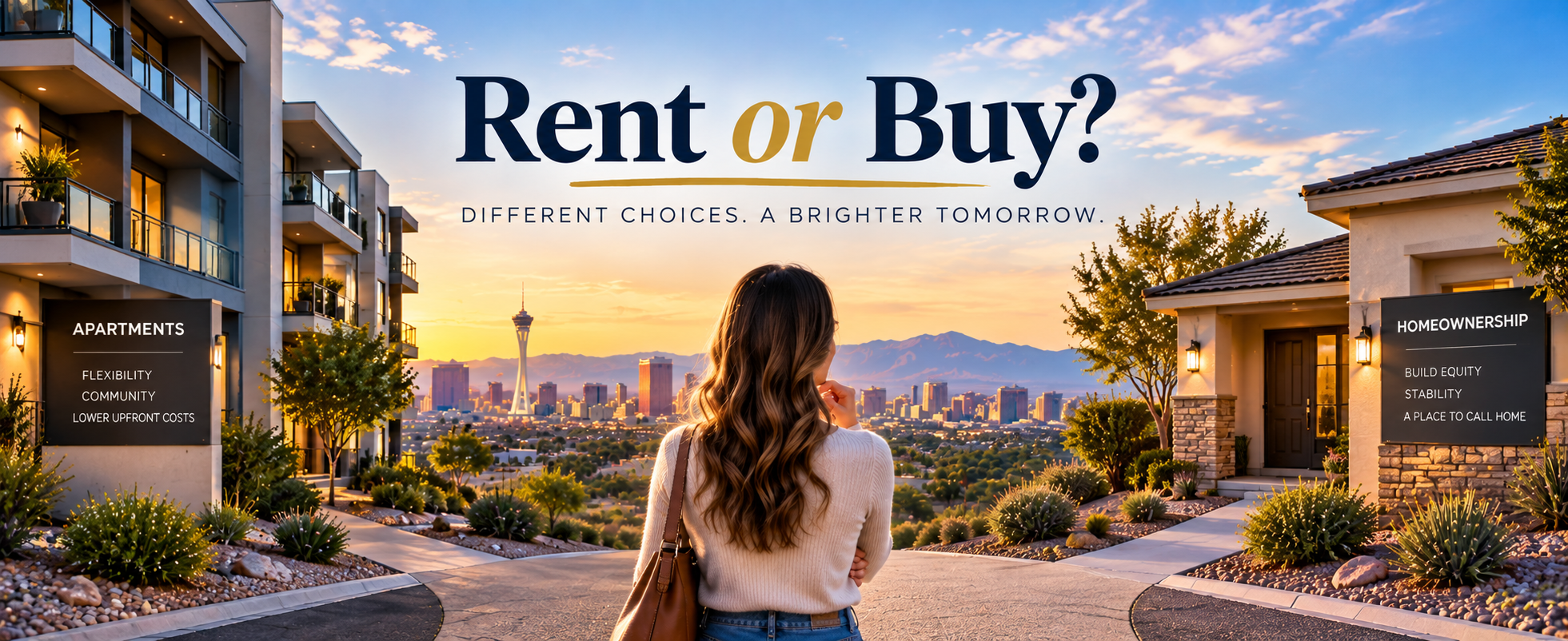
Rent vs. Buy in Nevada
Should You Keep Renting or Buy a Home?
Is it better to keep renting or buy a home in Nevada? The answer depends on more than your monthly housing payment. Your finances, lifestyle, future plans, local housing market, and how long you expect to stay in the home can all influence the decision.
Buying may provide stability, greater control over your living space, and the opportunity to build equity. Renting may offer more flexibility, lower upfront costs, and fewer maintenance responsibilities.
The better choice is the one that fits your circumstances and goals.
When Renting or Buying May Make More Sense
Renting May Make Sense If...
- You expect to move again relatively soon.
- You want greater flexibility.
- You are still building savings.
- Your employment or income may change.
- You do not want responsibility for major home repairs.
- You are still deciding which Nevada community fits you best.
Buying May Make Sense If...
- You expect to remain in the area for several years.
- Your income and employment are reasonably stable.
- You have funds available to purchase and maintain a home.
- You want the opportunity to build equity.
- You want greater control over your living space.
- You are comfortable taking responsibility for maintenance and repairs.
Renting vs. Buying a Nevada Home
| Consideration | Renting | Buying |
|---|---|---|
| Upfront Cost | Typically a security deposit, application expenses, and initial rent. | May include down payment, closing costs, inspections, appraisal, and other purchase expenses. |
| Monthly Housing Cost | Rent and applicable utilities or fees. | Mortgage payment, taxes, insurance, HOA fees if applicable, utilities, maintenance, and repairs. |
| Equity | Rent payments do not create ownership equity. | Homeowners may build equity as they pay down the mortgage principal and the property value changes. |
| Flexibility | Generally easier to relocate after the lease ends. | You may need to sell or otherwise address the property before relocating. |
| Maintenance | The property owner generally handles qualifying repairs. | The homeowner is responsible for maintenance and repairs. |
| Customization | Usually limited by the lease and property owner. | Greater ability to remodel, decorate, and improve the property, subject to applicable rules. |
| Housing Stability | Rent, lease terms, or property availability may change. | Ownership can give you more control over how long you stay in the property. |
Compare the Total Cost of Housing
Comparing monthly rent directly with a mortgage payment does not tell the whole story. Both renting and owning can involve additional expenses.
Possible Renting Costs
- Monthly rent
- Security deposit
- Application or administrative fees
- Renters insurance
- Utilities
- Pet fees, if applicable
- Parking or community fees
- Potential rent increases at renewal
Possible Homeownership Costs
- Mortgage principal and interest
- Property taxes
- Homeowners insurance
- Mortgage insurance, if applicable
- HOA fees, if applicable
- Utilities
- Maintenance and repairs
- Future improvements or renovations
What Does Building Equity Mean?
Home equity is generally the difference between a property's current market value and the amount owed against it.
As a homeowner pays down mortgage principal, the owner's equity may increase. Property values may also rise or fall over time, which can affect the property's equity.
Equity is one reason people consider homeownership as part of a longer-term financial strategy, but property appreciation is never guaranteed.
Renting Is Not Automatically a Bad Financial Decision
Renting can be a practical choice when flexibility is important, when you expect to move soon, or when buying would put too much pressure on your savings and monthly cash flow.
The goal shouldn't be to buy simply because you can. Your housing decision should fit your financial position and lifestyle.
Your Timeline Matters
Buying and eventually selling a home can involve transaction costs, so your expected time in the property is an important part of the rent-versus-buy decision.
Short-Term Plans
If you expect a job transfer, relocation, major lifestyle change, or another move soon, renting may offer more flexibility.
Several Years
If you expect to remain in the same Nevada community for several years, buying may become more attractive depending on financing, ownership costs, and market conditions.
Long-Term Plans
Buyers planning to stay in a home longer may have more time to build equity and spread purchase and future selling costs over a longer period.
8 Questions to Ask Yourself
How long do I expect to live here?
Your expected timeline can significantly affect whether renting or buying makes sense.
How stable is my income?
Homeownership generally works best when your housing payment and other ownership expenses fit comfortably within your budget.
How much cash do I have available?
Consider down payment, closing costs, moving expenses, emergency reserves, and other financial priorities.
What monthly payment feels comfortable?
The maximum mortgage amount you qualify for does not necessarily equal the amount you should spend.
Am I ready for maintenance?
Homeowners should plan for routine upkeep and unexpected repairs.
Do I want to customize my home?
Ownership usually gives you more freedom to renovate, improve, decorate, and personalize a property.
Do I know where I want to live?
Renting can provide time to explore Nevada communities before committing to a particular neighborhood.
What are my long-term housing goals?
Consider family needs, career plans, retirement goals, lifestyle preferences, and future space requirements.
Take the Next Step in Your Research
If buying may be the right direction, these Summit 23 Realty resources can help you better understand your options.
How Much House Can I Afford?
Explore income, debt, payment, and affordability factors that can affect your homebuying budget.
Explore Affordability →First-Time Homebuyer Guide
Learn the major steps involved in purchasing your first Nevada home.
Read the Buyer Guide →Nevada Home Loans
Review common financing options and questions to discuss with a qualified mortgage lender.
Explore Home Loans →Nevada Down Payment Assistance
Learn about Home Is Possible and Worker Advantage programs available to qualifying Nevada buyers.
Explore Assistance Programs →Rent vs. Buy Can Look Different Across Nevada
Home prices, rental availability, commuting patterns, neighborhoods, amenities, and lifestyle considerations vary considerably across Nevada.
Southern Nevada
Buyers considering Las Vegas, Henderson, Summerlin, Inspirada, Anthem, Lake Las Vegas, and surrounding communities should compare housing costs with commute times, HOA expenses, neighborhood amenities, and long-term plans.
Moving to Las Vegas GuideNorthern Nevada
Reno, Sparks, and surrounding Northern Nevada communities offer different housing, employment, transportation, and lifestyle considerations that may affect the rent-versus-buy decision.
Moving to Reno GuideNevada Rent vs. Buy FAQs
Is buying always better than renting?
No. Renting and buying can both be reasonable choices. The better option depends on your finances, timeline, lifestyle, housing needs, and local market conditions.
Does a mortgage payment simply replace rent?
Not exactly. Homeowners may also pay property taxes, homeowners insurance, mortgage insurance, HOA fees, utilities, maintenance, and repairs.
Do I need 20% down to buy a home?
Not necessarily. Mortgage programs have different down payment requirements, and some qualified buyers may qualify for lower down payment options or homebuyer assistance programs.
Can buyers get help with a down payment?
Some Nevada programs may assist qualified buyers. Certain programs are available to qualifying repeat buyers and first-time buyers.
Should I buy if I may move in a year or two?
A shorter timeline can make renting more attractive because buying and selling involve transaction costs. Evaluate your specific circumstances individually.
How should I compare renting with buying?
Compare total housing costs, upfront cash requirements, expected length of ownership, maintenance costs, financial reserves, lifestyle needs, and the value you place on flexibility versus ownership.
Could Buying a Nevada Home Make Sense for You?
Summit 23 Realty can help you explore Nevada homes, communities, and current real estate opportunities so you can compare your options and make an informed decision.
Search Nevada Homes Contact Summit 23 RealtyThis information is provided for general educational purposes only and is not financial, mortgage, tax, legal, or investment advice. Housing costs, rents, home prices, mortgage terms, interest rates, taxes, insurance, HOA fees, maintenance expenses, property values, and market conditions vary by property, location, and individual circumstances. Summit 23 Realty is a real estate brokerage and does not determine mortgage qualification or loan terms. Consumers should consult appropriate mortgage, financial, tax, legal, insurance, and other qualified professionals when evaluating whether renting or buying is appropriate for their circumstances.